


Discover how DMARC, DKIM, and SPF work together for email authentication. Learn the hidden risks of not securing your domain against email spoofing.
View More
If you document a security risk but don’t address it, you may face greater legal consequences than if you never assessed at all. Ignored risks become proof of negligence when breaches or lawsuits occur.
A risk assessment works by scanning your systems, flagging weak points, and handing you a report—but the report itself fixes nothing. What happens between that handoff and whatever you do next determines whether the exercise protected your business or quietly exposed it.
Once a weakness is written down, it stops being a mystery and starts being a fact on record. If that same weakness later causes a breach or lands you in legal trouble, the report becomes the evidence that you knew and didn't act.
IT security risk assessments exist to surface weaknesses in your systems and processes before attackers or accidents exploit them, and to point you toward the fix. Treat the findings as a to-do list rather than a filing exercise, because skipping the follow-through can open your business to more than technical headaches.

Most businesses run IT security risk assessments to protect their systems and data, yet the real exposure often shows up only after the report is filed. Once a risk is written down and then set aside, that document becomes proof you were aware of the problem.
Should a security incident happen later, the same documentation can show you knew about the risk and chose not to fix it, which is a very different position from never having known at all. In legal terms, failing to act on a known risk can be treated as negligence.
Courts and regulators tend to look for evidence that a business took reasonable steps to protect information, so a weak password policy flagged in your assessment and then left alone can leave you responsible if that exact weakness gets exploited. The paper trail that was meant to protect you ends up working against you.
None of this is theoretical. Regulatory frameworks covering healthcare or financial data generally expect businesses to act on security risk assessment results, and ignoring them can lead to fines, lawsuits, or even criminal penalties when sensitive data is exposed.
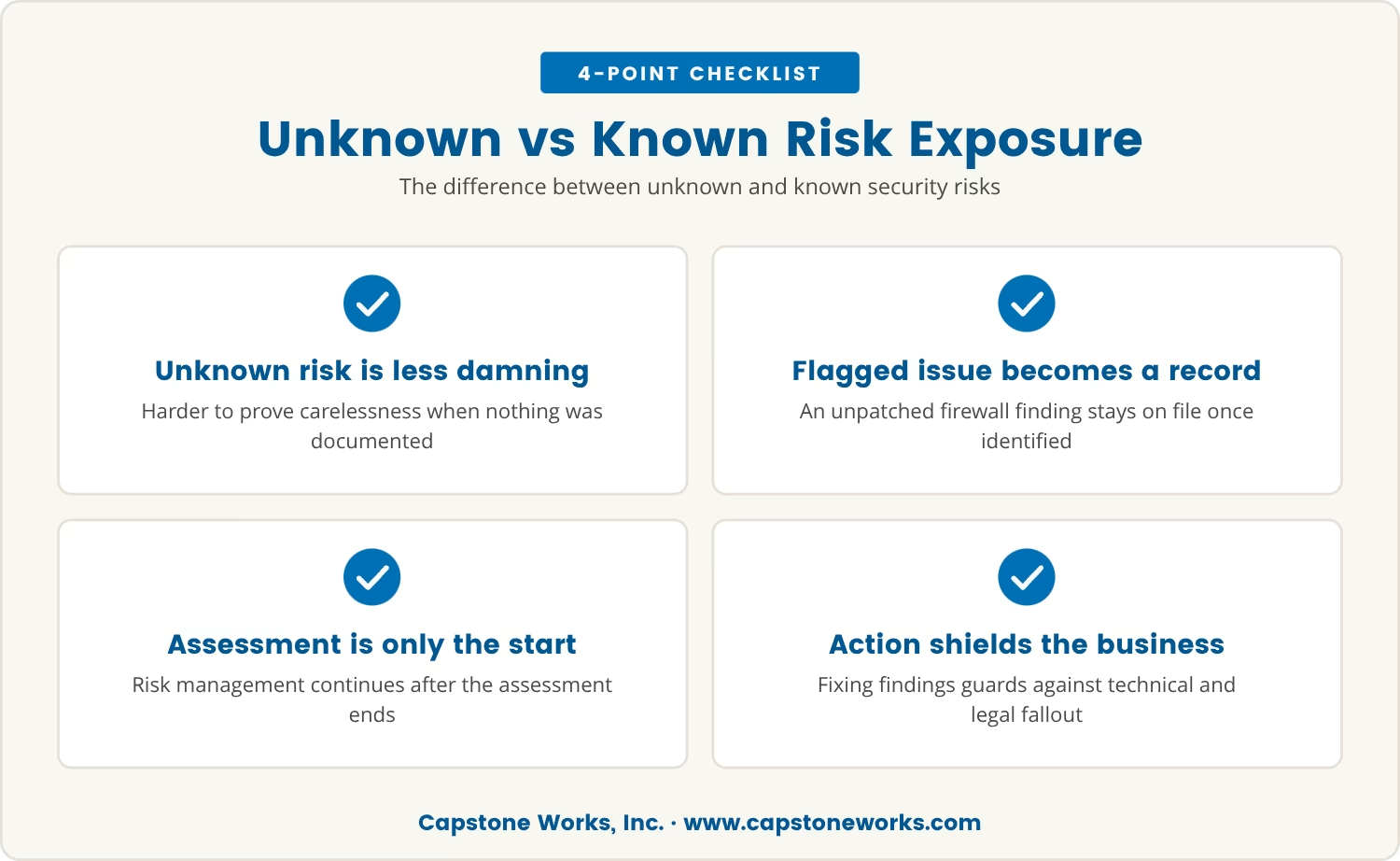
Not all risks carry the same weight in the eyes of the law. A risk you never identified sits in a different category than one you found and left unaddressed.
A breach tied to an unknown risk may still bring consequences, but proving carelessness is harder when nothing was written down. A documented risk removes that ambiguity: the record shows you had the chance to fix it, which raises your legal exposure considerably.
Picture an IT risk consultant flagging an outdated firewall that never gets patched. That finding is now part of your records, and if an attacker later gets through that same firewall, the fact that you knew and did nothing can be used against you.
Because of that gap between knowing and fixing, the IT risk management process doesn't end once the assessment is complete. It's the starting point. Acting on what you learn is what shields your business from both the technical damage and the legal fallout that follows.
A documented risk doesn't just sit quietly in a file. In Cedar Park and beyond, that same document can surface as a key piece of evidence if a security breach leads to an investigation or lawsuit.
Legal teams, regulators, and even insurance companies may request your security risk assessment reports, and if those reports show a problem identified but never fixed, they can argue you failed in your duty to protect your data and your customers.
That argument carries extra weight in industries bound by strict information security rules. Healthcare providers answer to HIPAA, financial firms answer to their own set of regulations, and in both cases a documented but ignored risk can be treated as a violation.
Even outside a regulated industry, general business law still applies. Negligence claims often turn on what a "reasonable" business would have done, and a gap your own assessment found but left open is a hard thing to defend.

A strong assessment process doesn't stop at finding problems; it builds in the steps that make sure those problems get addressed. Here's how a well-run process moves from discovery to resolution:
The first step is finding every possible security risk across your IT environment, including technical weaknesses, outdated software, and gaps in policy. This stage sets the scope for everything that follows.
Next comes evaluating how likely each risk is to be exploited and what the fallout would look like if it were. That evaluation is what lets you prioritize which issues deserve attention first.
With priorities set, the next move is building a plan to address the most serious risks. That plan might mean updating software, changing procedures, or training staff.
The plan then gets put into action: installing new security tools, changing passwords, or setting up new access controls. This is where intentions turn into actual changes on the ground.
Finally, progress gets tracked, and your security posture gets reviewed on a regular basis. This step confirms that fixes are holding and catches new risks as they emerge.
Each stage depends on the one before it, so skipping any of them—especially the follow-up—can leave your business exposed despite a thorough assessment.
Good intentions are rarely the problem; follow-through is. Here are some of the common reasons assessment findings stall out before they're fixed:
These obstacles are real, yet none of them change the underlying fact that ignoring a known risk tends to cost more the longer it sits. Addressing problems early is consistently safer than explaining them after the fact.
Making sure your IT security risk assessment leads to real improvement starts with assigning clear responsibility for each finding, so someone is accountable for fixing every issue rather than everyone assuming someone else will.
From there, set deadlines for the highest-priority risks and check in on progress regularly so nothing quietly falls through the cracks. Use your assessment tool to document what's been fixed and what's still outstanding.
If you're not sure where to start, ask yourself: which risks would cause the most damage if left unaddressed? Focusing there first lets you make the biggest impact with the resources on hand.
Bringing in an IT risk consultant can sharpen that prioritization further, guiding you through the risk management process and lining up your actions with your broader business goals.
Failing to act on known risks costs more than money. It can damage your reputation, erode customer trust, and lead to legal trouble that's hard to recover from.
When a breach happens, the question that follows isn't just "what went wrong," but "what did you know, and what did you do about it?" Answer "nothing," and the consequences can reach far beyond the original problem.
Acting on your IT security risk assessment findings is not just about compliance. It's about protecting your business from risks you can't afford to ignore.

Many businesses with 25 to 75 employees find themselves with a list of risks after an assessment, but not always a clear plan for what comes next. At Capstone Works, Inc., we understand how easy it is for these findings to slip down the priority list when you’re busy running your business.
We invite you to see how we help businesses turn risk assessments into real, practical improvements—so you’re not left exposed by inaction. Let’s talk about your current setup and what steps make sense for you.
Try our services risk-free: if you’re not satisfied after 60 days, we’ll refund 100% of your fees—no questions asked.
A risk assessment identifies and evaluates potential threats to your IT systems, while a security assessment tests your current defenses to see how well they hold up. One tells you what could go wrong; the other tells you how prepared you are right now.
Most businesses in this size range should run a cybersecurity risk assessment at least once a year, or whenever major changes hit their systems or processes. Regular reviews catch new risks as the business and its technology evolve.
Responsibility usually falls to the IT manager or a designated security officer, though business leaders should stay involved throughout. Clear ownership for each action item keeps nothing overlooked and keeps risk management efforts on track.
Addressing some risks beats ignoring all of them, but known gaps left in place can still create legal and technical exposure. Prioritize the most serious issues first, then build a plan to work through the rest over time.
Yes, a good assessment tool helps track risks, assign tasks, and monitor progress as they happen. It also creates a record of the actions taken, which can matter if you ever need to show that reasonable steps were taken to protect your business.


Discover how DMARC, DKIM, and SPF work together for email authentication. Learn the hidden risks of not securing your domain against email spoofing.
View More

Explore the benefits of IT outsourcing, including improved support coverage and access to specialized expertise, to enhance your business operations.
View More


.svg)


