



Explore how CMMC compliance impacts your business strategy. Understand the risks of over-certifying and learn to align with actual CMMC requirements.
View More
A HIPAA compliance checklist only protects your practice if business associate agreements are treated as ongoing controls. Filing them away after onboarding leaves you exposed when vendors change their data handling.
A signed business associate agreement works like a snapshot: accurate the day it's taken, but static while the vendor behind it keeps changing. The vendor's technology shifts, its subcontractors rotate, its storage methods evolve, yet the paperwork sits untouched in a file.
That mismatch is where the danger builds. A checklist that stops at onboarding leaves a practice blind to how vendors handle protected health information (PHI) once their systems and processes move on from what the original agreement assumed. A vendor that adopts new technology or changes how it stores or shares data can quietly drift outside the terms it originally signed, and that drift can lead to data breaches, regulatory fines, and a loss of patient trust.
A HIPAA compliance checklist works best as a living process rather than a stack of forms, since it is meant to track how partners handle sensitive health information as that handling changes. Staying HIPAA compliant, then, means treating business associate agreements as ongoing controls rather than paperwork filed away and forgotten.

A business associate agreement (BAA) is a legal contract defining how a vendor handles PHI, not a formality to file and forget. Because the way vendors use, store, or transmit data shifts over time, an agreement left unreviewed stops matching the vendor's actual practices, and that mismatch is exactly where new vulnerabilities take root.
Consider a vendor that switches to a new cloud provider or adds a third-party tool never covered in the original agreement. Left unexamined, changes like these can open the door to unauthorized disclosures or breaches.
Regular review catches these shifts before they turn into incidents. It also creates a natural checkpoint for clarifying expectations, updating security requirements, and confirming that both parties still meet HIPAA IT requirements — a necessity for covered entities that depend on outside partners to process or store ePHI.
Once a vendor changes its systems or processes, the safeguards written into the original agreement may no longer hold. A business associate that adopts a new data storage method, for instance, can end up operating under encryption standards the agreement never anticipated.
That leaves a gap between what the agreement says and what is actually happening day to day. Should a breach occur, regulators will examine whether the agreement was current and whether reasonable steps were taken to keep compliance ongoing rather than assumed.
Even modest changes — a vendor hiring a subcontractor, updating its own privacy policy — can widen that gap considerably. For that reason, a HIPAA compliance checklist needs regular review of every business associate agreement built into it as a standing step, not an afterthought.
Since gaps tend to open after onboarding rather than during it, a strong HIPAA compliance checklist for Cedar Park organizations has to extend past the initial paperwork into ongoing monitoring. The essentials include:
Together, these steps close the exact gap that a one-time checklist leaves open — the risk of a vendor change going unnoticed until it causes harm.
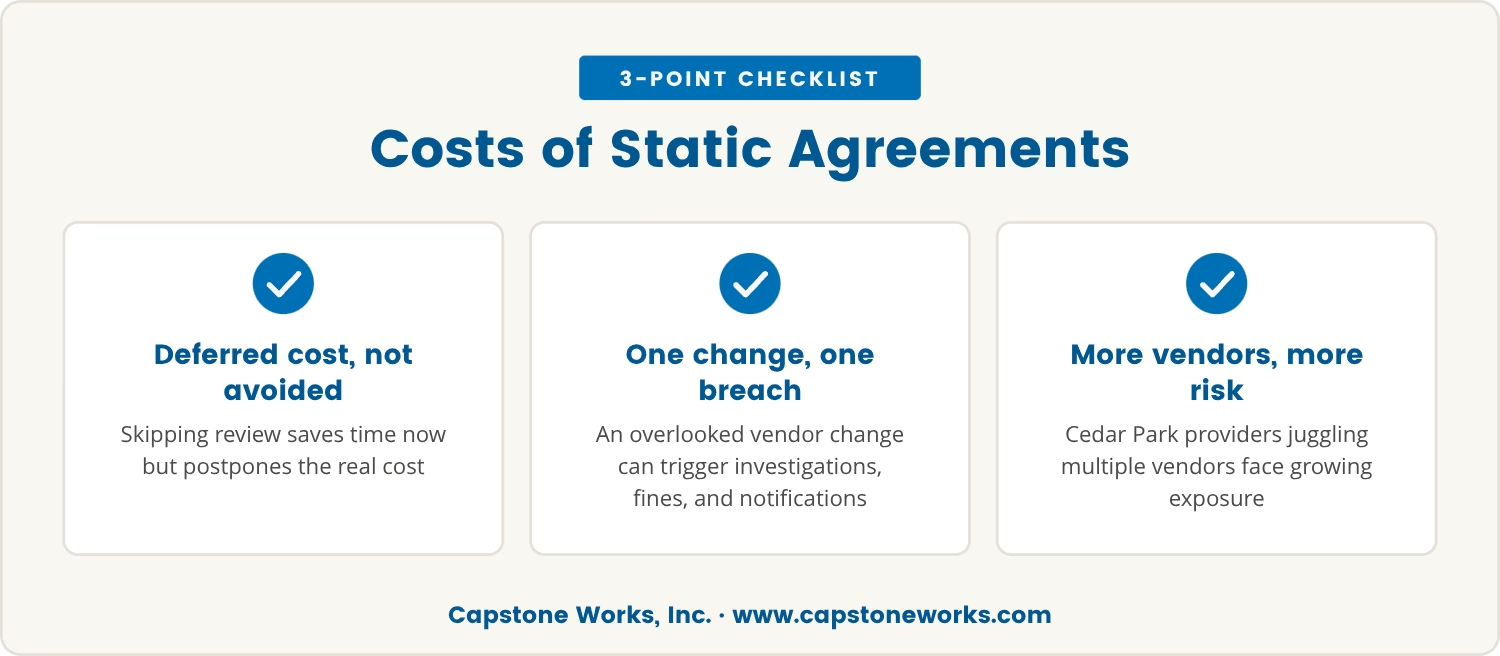
Skipping that ongoing review saves time upfront, but treating business associate agreements as static documents defers the cost rather than avoiding it. A single overlooked change in a vendor's process can lead to a breach of protected health information, and a breach like that can trigger regulatory investigations, fines, and mandatory notification to every patient affected.
Financial penalties are only part of what's at stake, since reputation takes the harder hit. Patients expect their health information to be handled securely, and discovering that a breach traced back to an outdated or ignored agreement makes trust difficult to rebuild.
In Cedar Park, where healthcare providers often juggle multiple vendors at once, that risk of something slipping through the cracks only grows with each added relationship. Keeping agreements current is a practical, concrete way to protect both the business and the patients it serves.
Because the risks above stem from agreements that stand still, a living business associate agreement needs to adapt as the organization and its vendors evolve. The elements below are what make that adaptability real.
Define exactly what services the vendor provides and what PHI they access. This ensures both parties understand their responsibilities.
List the technical safeguards required, such as encryption and access controls, and update them as technology and risks change.
Spell out how and when the vendor must notify you in case of a breach, following the breach notification rule.
Require the vendor to have agreements with any subcontractors who handle your PHI, and to inform you of any changes.
Set a timeline for reviewing and updating the agreement, such as annually or after any major change in services.
Describe what happens to your PHI if the agreement ends, including secure data return or destruction.
With those elements in place, the next question is who keeps them current. A responsive HIPAA program means policies and procedures get reviewed and updated regularly — not only when regulations change, but whenever the business or its vendors do. That habit is what surfaces gaps before they turn into problems.
One practical step is assigning ongoing risk assessment and agreement review to a specific person or team, so someone is always watching for changes that could affect compliance.
When was the last time you checked whether your vendors have changed how they handle PHI? If that question doesn't have a quick answer, the process is overdue for a second look.
All of this points back to what a HIPAA compliance checklist is actually for: not checking boxes, but building habits that keep an organization safe as circumstances change around it. Business associate agreements fit into that same logic — they are living controls, not paperwork filed once and left alone.
Treating those agreements as ongoing commitments cuts the risk of breaches, fines, and lost trust all at once. It also builds a culture of compliance that protects the business and its patients, in Cedar Park and well beyond it.

Many organizations with 25 to 75 employees find themselves unsure if their vendor agreements still match how data is handled today. At Capstone Works, Inc., we know that keeping up with these changes can feel overwhelming.
If you want to see how we approach ongoing HIPAA compliance or want to talk through your current setup, we're here to help.
If you’re not satisfied after 60 days, Capstone Works, Inc. will refund 100% of your fees—so you can review your compliance risk with confidence.
Review business associate agreements at least once a year, or whenever a vendor changes how it handles protected health information. Regular reviews keep agreements aligned with current practices and keep the organization compliant.
Update the agreement to reflect the new processes and confirm that all HIPAA requirements are still being met. This may include revisiting safeguards like encryption or access controls.
Both covered entities and business associates share responsibility for following the HIPAA privacy rule. It falls to the covered entity, though, to make sure agreements stay current and that vendors are meeting their obligations.
A breach paired with an outdated agreement can mean regulatory penalties and a requirement to notify affected individuals. Keeping agreements up to date lowers this risk and demonstrates that reasonable steps were taken to protect PHI.
A template works as a starting point, but every agreement should be tailored to the specific services and risks involved. Customizing agreements ensures they cover the particular ways each vendor interacts with PHI.


Explore how CMMC compliance impacts your business strategy. Understand the risks of over-certifying and learn to align with actual CMMC requirements.
View More

Discover how DMARC, DKIM, and SPF work together for email authentication. Learn the hidden risks of not securing your domain against email spoofing.
View More


