



Discover how DMARC, DKIM, and SPF work together for email authentication. Learn the hidden risks of not securing your domain against email spoofing.
View More
Chasing the highest CMMC level you can afford, instead of the level your contracts require, wastes money and slows down certification. Overbuilding compliance means fewer resources for winning and delivering on contracts.
Picture two companies bidding on the same Department of Defense contract. One spends eighteen months and a six-figure budget certifying to a level three tiers higher than the contract requires; the other matches its certification to the exact level specified and starts bidding months earlier. The gap between them isn't security. It's strategy.
That gap is worth sitting with, because the instinct to over-certify is common and it rests on a misunderstanding of what CMMC compliance is actually for. CMMC compliance exists to meet the exact standards your contracts require—not more, not less. Once that distinction is clear, the levels and requirements stop feeling like a maze and start functioning as a map: understanding what each level covers, and why it exists, is what keeps you from doing unnecessary work and burning budget you'll need later.

Aiming for the top CMMC level feels like a statement of commitment to security, and on paper that looks like a strength worth having. In practice, it tends to create more problems than it solves.
The reason is structural: each level stacks new security controls and documentation on top of the last. Climb higher and you spend more time and money on assessments, policies, and technical upgrades, which in turn delays your ability to bid on contracts that only needed a lower level in the first place.
So if your contracts call for Level 1 or Level 2, pushing for Level 3 means paying for controls you don't need. That same money could instead fund staff training, technology upgrades, or a push into more contracts.
The outcome is often the opposite of what businesses expect: rather than standing out, you end up stuck in a longer, costlier certification process, with less flexibility and fewer resources left for the goals that actually grow the business.
Seeing why overbuilding backfires only matters once the levels themselves are clear. The CMMC 2.0 framework has three levels, each one calibrated to the sensitivity of the information a business handles.
Since most contracts specify which level applies, meeting a higher level than required doesn't strengthen your bid—it just adds workload and cost without a matching return.
That same logic holds for businesses in Cedar Park, where the CMMC program carries the same weight it does anywhere else. What shifts locally is not the requirement but the tradeoff: the local business environment shapes how much overbuilding actually costs you.
If your company sits inside the defense industrial base, or works as a subcontractor to one, you need to know precisely which CMMC level your contracts demand. Overbuilding your compliance program ties up funds that could otherwise go toward local hiring, equipment, or expanding what you offer.
Targeting the right level, rather than the highest one, lets you move faster and stay competitive without the unnecessary expense. In a market where every dollar and day counts, that's what keeps a business agile.
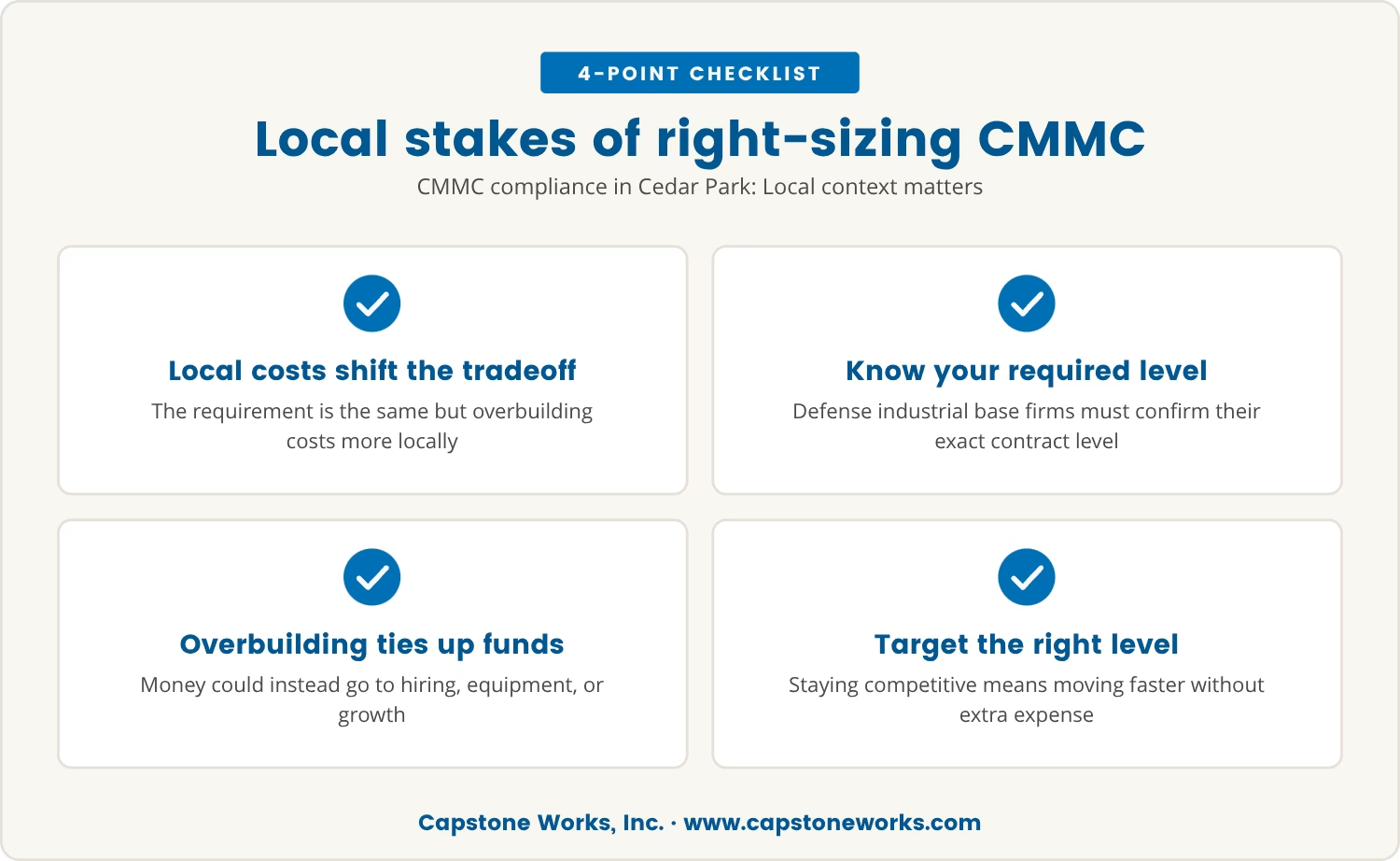
That agility is exactly what gets lost once a business pursues a higher CMMC level than its contracts require, because the certification process grows more complicated at every stage. The mechanism works like this:
Together, these factors push back your certification timeline, and a delayed timeline often means missed contract opportunities while approval is still pending.
Delays are the visible cost; they show up in missed deadlines. But organizations tend to focus only on the costs they can see upfront, like assessment fees and technology upgrades, while a second layer of cost builds quietly underneath.
Aiming higher than necessary means paying more for ongoing maintenance, since every added control or process has to be managed, reviewed, and updated indefinitely. That adds to long-term expenses and stretches teams thinner than the certification decision ever seemed to warrant.
There's also a quieter risk: losing focus on the goals that actually drive the business. Time spent on unnecessary compliance is time not spent on innovation, customer service, or contract delivery.
Have you reviewed your current contracts to see which CMMC level is actually required? That single check can save you from spending on controls you don't need.

Answering that question is really the whole exercise: matching compliance to business need, rather than to ambition. Here's a step-by-step approach to getting there.
Check the language in your current and upcoming contracts. Most will state the required CMMC level directly.
Determine if you work with Federal Contract Information (FCI), Controlled Unclassified Information (CUI), or more sensitive data, since that classification drives the level you need.
List the controls needed for each level, then focus only on the level your contracts actually require.
Compare your existing security measures against the requirements for your needed level, and use the gaps you find to plan targeted improvements.
If you expect to bid on contracts that require a higher level down the road, prepare a roadmap now but hold off upgrading until those opportunities become real.
Don't invest in controls or assessments that go beyond your contract needs; save those resources for growth or contract performance instead.
Skipping that discipline is what lets a compliance program drift past what the business actually needs, and several risks follow directly from that drift:
Every one of those risks traces back to the same root cause: losing sight of what CMMC compliance is actually meant to do, which is meet the requirements of your contracts and protect sensitive information, nothing more. Going beyond that bar may look like a way to stand out, but it tends to produce wasted resources and slower growth instead.
Focusing on the right level keeps the business efficient and ready to compete, and it frees up the team to focus on what matters most: winning contracts and delivering strong results.

Many businesses with 25 to 75 employees feel pressure to over-invest in compliance, especially when CMMC requirements seem complex or unclear. At Capstone Works, Inc., we understand how easy it is to get pulled into chasing higher certification levels than your contracts actually demand.
We invite you to talk with our team about your current contracts and business goals. Let’s look together at how a focused approach to CMMC can keep your resources working for you.
If you’re not satisfied after 60 days, we’ll refund 100% of your fees—so you can pursue the right CMMC level without risk.
Review the requirements listed in your current and upcoming contracts, since most Department of Defense contracts specify the CMMC level you must achieve. Handling only Federal Contract Information typically means Level 1 is enough, while working with Controlled Unclassified Information usually requires Level 2.
You end up spending more time and money on compliance tasks that may not benefit your business, since higher levels require additional security controls, documentation, and assessments. That added burden can slow down your certification, tie up resources you could use elsewhere, and delay your ability to start or win contracts.
Unless your contracts or target clients specifically require a higher level, there is little practical benefit, since most contracting officers care only that you meet the level specified. Achieving a higher level does not guarantee more business or a competitive edge when the contract never called for it.
Focus on the exact requirements your contracts specify, and avoid adding extra controls or processes unless you know a future contract will need them. Reviewing your compliance program regularly helps confirm it still matches your business needs and budget.
Update your compliance program once you start handling more sensitive information or plan to bid on contracts with higher CMMC requirements. Build a roadmap for upgrading your security controls, but invest only when those changes become necessary for your business.


Discover how DMARC, DKIM, and SPF work together for email authentication. Learn the hidden risks of not securing your domain against email spoofing.
View More
Discover how an IT security risk assessment can expose legal risks if findings are ignored. Learn the importance of follow-through in risk management.
View More


